32-Inch Carbon Bicycle Rims: Specifications, Compatibility, and Applications
32-Inch Carbon Rims: Bigger Wheels, Undefined Standard
Large-diameter carbon rims are moving from custom curiosities into real build discussions. The obstacle isn't the carbon — it's that "32 inch" still means whatever the supplier says it means.
For most of cycling's recent history, wheel diameter has been settled territory. Road settled on 700c. Mountain settled on 29-inch. Gravel borrowed both. Then a small group of builders, tourers and custom-frame specialists started asking a different question: what if the wheel simply got bigger?
That question has produced a quiet but persistent niche for 32-inch carbon rims. They appear in tall-bike builds, long-distance touring projects, prototype frames, and the occasional design study where a conventional 29-inch wheel looks out of proportion. The rims exist. The tires, hubs and frames are catching up. What hasn't caught up is the language used to describe them.
“32 inch” is a label, not a specification. On a carbon rim, the label tells you almost nothing about whether the wheel will fit, brake, or hold air.
The central problem with large-diameter rim sizing
Why builders are looking at 32 inches
Larger wheels roll over obstacles more easily and hold momentum better, which is why 29-inch wheels displaced 26-inch in mountain biking. The same logic, pushed further, appeals to builders working on utility bicycles, cargo-adjacent designs and touring setups where ride quality matters more than acceleration.
Carbon adds a second argument. A large aluminum rim gets heavy quickly; a well-made carbon rim can offset some of that diameter penalty. That combination — big diameter, manageable weight — is what makes a 32-inch carbon project plausible rather than merely eccentric.
But plausibility is not compatibility. And compatibility is where most 32-inch projects run into trouble.
The measurement problem is the real story
There is no universal, widely enforced ISO/ETRTO designation that a buyer can rely on when a catalog says “32 inch.” Depending on the supplier, the number may refer to a nominal wheel diameter, an outer rim diameter, a bead-seat diameter, or a marketing convention inherited from another product category.
Two rims both sold as “32 inch” can therefore differ in bead-seat diameter — the only number that actually determines whether a tire mounts and stays mounted. Measuring a built wheel or a mounted tire is not a substitute, because tire height and rim profile both distort the result.
The practical rule for buyers is simple and non-negotiable: request the bead-seat diameter and the ISO/ETRTO equivalent in writing before ordering, and treat the nominal size as a category label only.
What a 32-inch carbon rim specification actually contains
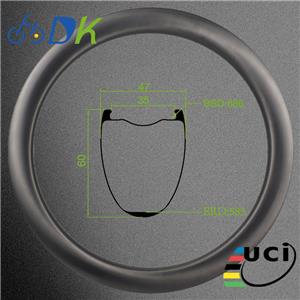
A usable specification goes well beyond diameter. The table below shows the parameters that determine whether a rim can be built, mounted and ridden safely. Values are illustrative of the categories a supplier should provide — not a universal standard.
| Parameter | What to confirm | Why it matters |
|---|---|---|
| Bead-seat diameter | Exact value, plus ISO/ETRTO equivalent | Determines tire fit; nominal “32 inch” is not enough |
| Internal width | Distance between bead seats | Sets the approved tire-width range |
| External width | Outer wall measurement | Frame, fork and fender clearance |
| Rim depth / profile | Section and shape | Spoke length, handling, brake reach |
| Hook type | Hooked or hookless | Restricts approved tires and pressure limits |
| Spoke holes | Count and drilling angle | Hub matching and build viability |
| Brake interface | Disc or rim brake; track material if rim brake | Determines hub, pads and frame mounts |
| Max pressure | Rim and tire limits, whichever is lower | Hookless and large-volume setups are sensitive |
| System weight limit | Rider + bicycle + load | Large-diameter wheels carry different loads |
Hooked or hookless changes the tire conversation
Hooked rims use inward-facing edges to retain the bead. Hookless rims rely on a different retention system and stricter tolerances, and they are only safe with tires the rim maker has explicitly approved at the specified width and pressure.
For a 32-inch carbon rim, this distinction should be settled before any tire is selected. A tire that mounts cleanly can still sit outside the approved width or pressure range — and on a large-diameter hookless rim, that margin matters more, not less, because the air volume and bead loads are different from a 29-inch wheel.
Brakes, hubs and the rest of the system
Rim-brake 32-inch carbon rims need a dedicated braking surface and pads approved for that surface. Disc-brake versions shift the constraint to the hub standard, rotor mount and axle configuration — and to whether the frame and fork can physically clear a wheel this large under braking load.
Spoke count and drilling angle deserve equal attention. A 32-inch rim built with the wrong hub flange geometry or incorrect spoke length will not tension evenly, and uneven tension on a large-diameter carbon rim is a durability problem, not a tuning detail.
Where 32-inch builds make sense
This is not a mainstream size, and treating it as one leads to bad purchasing decisions. It fits specific projects:
- Custom and tall-bike builds where frame geometry is designed around the diameter
- Specialized touring and utility bicycles prioritizing rollover and ride quality
- Prototype and design-study frames
- Projects where the frame maker has explicitly approved the wheel size
In every case, the frame is the gatekeeper. A larger wheel changes wheelbase, trail, brake reach, mudguard space and tire clearance. Approval from the frame builder should come before the rim order, not after.
Quality checks that matter more at this diameter
Large rims amplify manufacturing variation. Before building, inspect for cracks, delamination, sharp edges, loose fibers, bead-seat damage and abnormal deformation. Ask the supplier for dimensional inspection records, spoke-hole preparation details and final inspection standards.
Do not build or ride a rim with visible structural damage or an uncertain impact history. On a nonstandard size, replacement lead times are longer and the cost of a failure is higher.
Ordering checklist
- What exact bead-seat diameter does “32 inch” represent?
- Is the size stated per ISO/ETRTO, and what is the equivalent?
- What are the internal and external widths?
- Is the rim hooked or hookless?
- Which tire models, widths and pressures are approved?
- Which brake systems and hub standards are supported?
- Spoke-hole count and drilling angle?
- System weight limit?
- Inspection, warranty and damage-replacement terms?
What this means for buyers and builders
The 32-inch carbon rim is a real product category now, but it is still a custom category. The carbon is not the hard part. The hard part is agreeing on what the number means, then confirming that the tire, hub, brake, frame and fork all accept that answer.
For projects moving in this direction, DK Composite works with builders to define rim diameter, profile, spoke drilling, brake interface and tire requirements against the intended application — with specifications confirmed for the finished wheel system rather than assumed from a product category.
Specifications referenced in this feature are illustrative. Always confirm final dimensions, tire approval, pressure limits and system weight ratings with the rim and frame manufacturers before building or riding.