Carbon Rim Weight: What Makes Some Rims Lighter Than Others?
Carbon rim weight is an important factor when choosing bicycle rims for road cycling, gravel riding, and performance wheelsets. However, carbon rims with the same dimensions can have noticeably different weights.
Why can two 45mm carbon rims have different weights? Does a lighter carbon rim always offer better performance? How do rim depth, carbon fiber layup, and structural reinforcement affect the final result?
This guide explains the key factors affecting carbon rim weight and compares real specifications from the DK Composite D35TL-30, D45TL-30, and D60TL-30 road rim series.
1. What Determines Carbon Rim Weight?
Carbon rim weight depends on much more than the carbon fiber material itself. The overall dimensions, laminate structure, and intended application all influence the finished weight.
The main factors include:
- Rim depth and diameter
- Internal and external rim width
- Carbon fiber grade and layup design
- Wall thickness and reinforcement
- Resin content and manufacturing quality
- Spoke hole and tire bead construction
Each factor affects the balance between weight, stiffness, durability, and manufacturing requirements. A lightweight carbon rim must still provide sufficient structural performance for its intended use.
2. How Does Rim Depth Affect Carbon Rim Weight?
Rim depth is one of the most visible differences between carbon road rims. Common profiles include 35mm for climbing, 45mm for all-round road cycling, and 60mm for aerodynamic applications.
When other design factors are similar, deeper rims generally require more material and may weigh more than shallower models.
35mm Carbon Rims: Lightweight Climbing
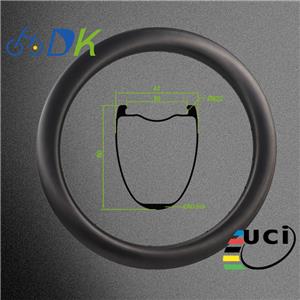
The DK D35TL-30 Lightweight Carbon Road Rim features a 35mm depth, 30mm external width, and 24mm internal width.
According to the published specifications, its T1100 version has a nominal weight of 280g with a tolerance of +/- 15g.
This shallow profile is designed for lightweight road wheel builds and climbing-oriented applications.
45mm Carbon Rims: Balanced Performance
The DK D45TL-30 Aero Carbon Road Rim combines a 45mm depth with a 30mm external width and 24mm internal width.
Its T1100 version has a published nominal weight of 320g, with a tolerance of +/- 15g.
The mid-depth design offers a balance between aerodynamic potential and wheel weight, making it suitable for versatile road wheelset projects.
60mm Carbon Rims: Aerodynamic Design
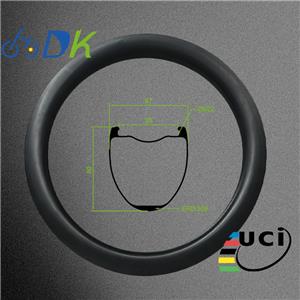
The DK D60TL-30 Aero Carbon Road Rim features a 60mm depth, 30mm external width, and 24mm internal width.
Its T1100 version has a published nominal weight of 400g, with a tolerance of +/- 15g.
Although the deeper structure adds weight compared with the shallower models in this series, it provides greater opportunity for aerodynamic shaping in high-speed road applications.
3. Real Carbon Rim Weight Comparison: 35mm vs 45mm vs 60mm
Comparing actual product specifications helps illustrate how rim depth influences carbon rim weight.
The following three DK Composite road rims share the same 700C diameter, 30mm external width, and 24mm internal width.
35mm Road Rim - D35TL-30
Depth: 35mm
External Width: 30mm
Internal Width: 24mm
T800 Weight: 350 +/- 15g
T1000 Weight: 320 +/- 15g
T1100 Weight: 280 +/- 15g
View D35TL-30 Product Specifications
45mm Road Rim - D45TL-30
Depth: 45mm
External Width: 30mm
Internal Width: 24mm
T800 Weight: 385 +/- 15g
T1000 Weight: 360 +/- 15g
T1100 Weight: 320 +/- 15g
View D45TL-30 Product Specifications
60mm Road Rim - D60TL-30
Depth: 60mm
External Width: 30mm
Internal Width: 24mm
T700 Weight: 460 +/- 15g
T800 Weight: 430 +/- 15g
T1100 Weight: 400 +/- 15g
View D60TL-30 Product Specifications
Note: All weights are published nominal values per rim, not complete wheelset weights. Actual product weight may vary within the stated tolerance.
Comparing the T800 versions, the 35mm rim is listed at 350g, the 45mm rim at 385g, and the 60mm rim at 430g.
This illustrates the general relationship between rim depth and weight within these three road rim models. However, weight differences between unrelated designs may be influenced by additional structural factors.
4. How Carbon Fiber Layup Affects Rim Weight
Carbon fiber layup is another major factor in lightweight carbon rim construction.
During manufacturing, carbon fiber prepreg layers are arranged in selected orientations and positions. The arrangement influences how the finished rim responds to different mechanical loads.
Areas around spoke holes, tire bead seats, and rim sidewalls may require different reinforcement strategies.
Careful layup design can help reduce unnecessary material while maintaining the required structural performance.
T800 vs T1000 vs T1100 Carbon Rim Weight
The DK D45TL-30 provides a useful product example.
With the same 45mm depth and 30mm external width, its published weight options include:
- T800: 385 +/- 15g
- T1000: 360 +/- 15g
- T1100: 320 +/- 15g
The nominal difference between the T800 and T1100 versions is 65g per rim.
This example shows how different carbon material and layup configurations can affect finished rim weight without changing the basic rim dimensions.
However, higher-grade carbon fiber does not automatically guarantee a lighter or stronger rim. Fiber properties, laminate design, resin systems, and manufacturing quality must all be considered.
5. Does Wider Rim Width Mean More Weight?
Rim width can also influence carbon rim weight. A wider cross-section may require additional material, depending on its design and structural requirements.
Modern road rims often use wider profiles to support contemporary tire sizes. However, a wider rim is not automatically heavier than every narrower alternative.
The finished weight depends on both geometry and construction.
Road Rims vs Gravel Rims
Road and gravel rims should be compared separately because their intended applications may require different widths and reinforcement designs.
For example, the DK D60TL-30 road rim has a 60mm depth and 30mm external width.
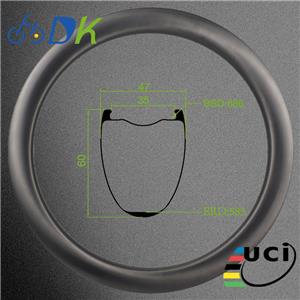
By comparison, the DK G60TL-47 Carbon Gravel Rim has a 60mm depth, 47mm external width, and 35mm internal width.
The gravel model uses a substantially wider profile for larger tires and demanding gravel applications.
Therefore, comparing these two rims based only on depth or weight would overlook important differences in their intended use.
6. Lightweight Carbon Rims vs Structural Strength
A common misconception is that the lightest carbon rim must always be the best choice.
In reality, rim weight must be balanced with structural requirements, durability, and riding conditions.
Why Reinforcement Matters
Carbon rims experience loads from spoke tension, tire pressure, road impacts, and repeated riding forces.
Manufacturers may reinforce critical areas to improve resistance to these loads. Additional reinforcement can increase weight, but it may be necessary to meet the intended performance and safety requirements.
Why Gravel Rims Need Different Construction
Gravel riding can expose rims to rocks, uneven terrain, and occasional tire bottom-outs.
The DK G60TL-47 uses a reinforced hook and flange structure designed to improve impact resistance in demanding gravel conditions.
This illustrates why the lightest possible construction is not always the most appropriate choice for every cycling application.
Does a Lighter Carbon Rim Make a Bike Faster?
Lower rim weight can reduce wheel rotational inertia and contribute to lower total bicycle weight.
However, actual cycling performance also depends on aerodynamics, tire rolling resistance, rider power, terrain, and the complete wheelset configuration.
A lightweight climbing wheelset and an aerodynamic racing wheelset may therefore use different rim designs.
7. How to Compare Carbon Rim Weight Correctly
When evaluating carbon rims from different manufacturers, buyers should consider the complete specification rather than focusing only on the advertised weight.
Important factors include:
- Dimensions: Compare rims with similar depth, width, and diameter.
- Weight Tolerance: Check both nominal weight and manufacturing tolerance.
- Carbon Layup: Understand available material and construction options.
- Intended Use: Compare road, gravel, and MTB products separately.
- Spoke Configuration: Verify drilling and wheel-building requirements.
- Testing: Review relevant structural and durability testing.
- Tire Compatibility: Confirm tire size and pressure requirements.
For professional wheel builders and bicycle brands, these factors are essential when selecting carbon rims for new wheelset projects.
8. Choosing Carbon Rims for OEM Wheel Projects
For bicycle brands, distributors, and wheel builders, carbon rim weight is an important part of wheelset development.
Different applications may require different priorities:
- Climbing Wheelsets: Lower weight and manageable handling.
- All-Round Road Wheelsets: Balanced aerodynamics, weight, and versatility.
- Aero Road Wheelsets: Deeper profiles for aerodynamic optimization.
- Gravel Wheelsets: Suitable tire support, durability, and impact resistance.
When discussing OEM carbon rim requirements, buyers should specify target weight, dimensions, tire compatibility, spoke hole configuration, and required testing standards.
Explore the DK Composite Carbon Road Rim Collection to compare available models and select suitable options for your project.
9. Frequently Asked Questions
What is a good weight for a carbon road rim?
There is no universal ideal carbon rim weight. It depends on rim depth, width, carbon layup, structural requirements, and intended use.
Why are some 45mm carbon rims lighter than others?
Differences in carbon fiber materials, layup design, wall thickness, and reinforcement can produce different weights even when rim dimensions are the same.
Does T1100 carbon fiber always make a rim lighter?
No. T1100 fiber alone does not determine final rim weight. The complete laminate design and structural requirements are equally important.
Are 35mm carbon rims lighter than 60mm rims?
Generally, shallower rims have lower weight potential when other construction factors are similar. In the DK T800 road rim examples, the 35mm model is listed at 350g and the 60mm model at 430g.
Is the lightest carbon rim always the best?
No. The best carbon rim balances weight, stiffness, durability, aerodynamics, and compatibility with its intended riding application.
Conclusion: Choosing the Right Carbon Rim Weight
Carbon rim weight depends on rim depth, width, carbon fiber layup, and structural reinforcement.
The DK D35TL-30, D45TL-30, and D60TL-30 road rims demonstrate how different depths and material configurations influence published rim weights.
For cyclists and professional buyers, choosing the right carbon rim means balancing lightweight construction with aerodynamic performance, durability, and wheelset requirements.
Explore DK Composite Carbon Road Rims or visit the DK Composite Official Website to discuss available rim specifications and OEM bicycle wheel projects.